Hours spent bridging systems.
Re-keying, chasing status, reconciling by hand. Routine work completes on its own across the systems you already use, inside the limits you set.
Observe. Control. Orchestrate.
Disconnected systems cost you twice: the hours your people spend bridging them, and the mistakes that slip through the gaps. We connect the ERP, CRM, and tools you already run, so routine work completes on its own, exceptions reach a person early, and every action leaves a record.
Four places. The same answer for each: the work runs across your systems, under the authority you set, with a record.
Re-keying, chasing status, reconciling by hand. Routine work completes on its own across the systems you already use, inside the limits you set.
The wrong status, the missed step, the invoice nobody matched. Every action carries its source. An action without one does not run. Exceptions reach a person early, with the evidence attached.
Sourced answers from your own records, each showing what was used.
A record for every action: what was read, what was decided, under which authority.
The answer is already in your company. It just isn't connected.
One discipline underneath all of it: AI is not authorized to invent an answer. When evidence is insufficient, the system cites, abstains, or escalates.
Each line is a test your team reruns, and the review hands you the first one.
You set the authority for each action, in four settings: Observe, it reports. Propose, it drafts and a person acts. Wait for approval, it acts after a person says yes. Run within policy, it acts on its own inside the limits you wrote. Routine work runs. Designated decisions pause. Outside-policy actions stop.
Six acceptance tests, agreed before the build and rerun by your team whenever you choose.
The cable-pull test: the network cable comes out, and the agreed functions keep working inside your boundary.
No action exceeds its authority: an action beyond its setting does not run.
Stop or ask when evidence is missing: without a source, the system stops or asks for review instead of answering.
Inspect and reconstruct: any action can be traced to what was read, what was decided, and who authorized it.
The blocked number: a figure without provenance cannot reach a report.
The exit drill: your team runs and rebuilds the system without us.
Pass conditions
The agreed functionality remains available after the network path is removed, on a boundary your own packet capture verified.
A pre-authorized action executes and records its result without manual approval; the same action set to wait for approval cannot execute until the authenticated human channel approves, enforced at the role and database layers. Both routes reconstruct from their authorization basis.
Low-confidence input follows the configured stop or human-review route, and the rate appears in the run report.
Any controlled action reconstructs from its record: input, policy version, model and prompt version, the authorization basis (policy version or authenticated approval), and the result, on an append-only, hash-chained journal.
A figure without provenance cannot reach a report; the gate blocks it and names the reason.
With all our access disabled, your team rebuilds the system from escrowed, hash-pinned artifacts using the runbook.
Built means implemented at the stated scope. Built and live means built and operated today. Verified reference means a tested reference implementation. Designed means architecture prepared for a future build. Research means published work. Each record in the practice register carries one of these labels.
What your company knows, from documents and mail to each customer's history and a key person's know-how, turned into answers with their sources.
Your systems connected, your data made usable again, recurring work automated with its approval rules, and web, mobile and internal applications built on top.
Your AI tested and kept within bounds: outputs attacked before they ship, permissions and approvals set, and every action kept in a journal.
How work really flows across your systems, where disputed numbers come from, reports that carry their sources, and forecasts scored against what happened.
We build around the systems you already run, whichever they are: an ERP such as SAP, Oracle, Microsoft Dynamics, Logo or Netsis; a CRM such as Salesforce or HubSpot; Microsoft 365 or Google Workspace; your databases and the spreadsheets in between.
The connections and permissions are defined for your business.
Private AI and local infrastructure, inside your own boundary and in your own racks, is an option on any lane, scoped per deployment.
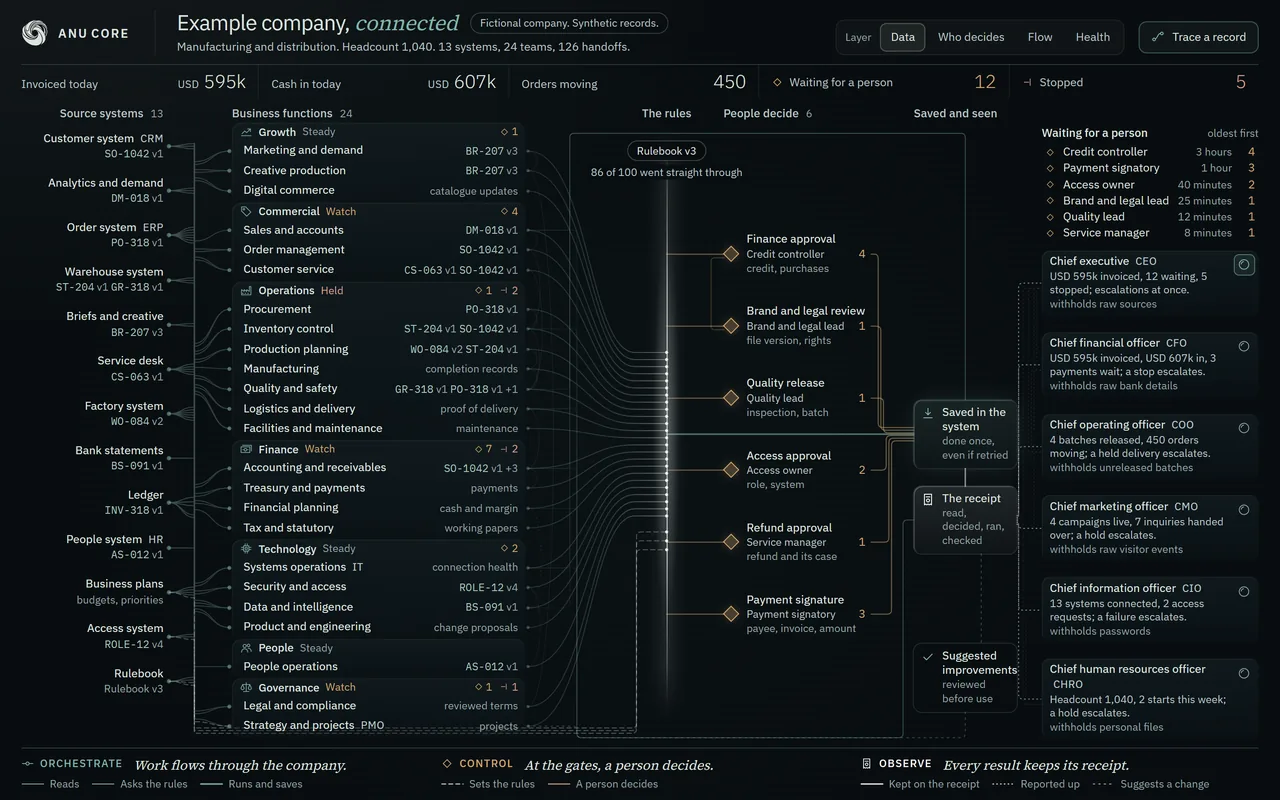
One fictional manufacturer and distributor, with synthetic records, run on these capabilities: work flows through its departments, a person decides at each gate, and every result keeps its receipt. Follow one order, open a decision, and watch the company carry it out.
It finds and ranks the companies worth a conversation. Sourced company discovery, deduplication, fit and buying-signal scoring, scheduled sweeps, and feedback from the people who use it.
It is one of eight records in the practice register: four Built, one Built and live, one Verified reference, one Designed, one Research.
Free. Fixed scope. It finds the first workflow worth changing and hands you four things: a baseline and a target; authority for each action; an acceptance test you can rerun; an expand-or-stop decision. Implementation is a separate, paid engagement, scoped after the review.
It needs no access to your systems and no private data to start. From a conversation about where work gets stuck, and from what is public about your company, you receive a general analysis and a proposal of what could be built for you. A look inside your systems happens only if you choose it, and then under your rules: what we may read, who takes part, and where the notes stay.
We read every request ourselves.
The review draws the boundary: what the system may read, what it may do, where it must stop.
Around the systems you already run, with the authority set per action.
Your team reruns the acceptance tests before anything is handed over.
Source, configuration, tests, and operating instructions move to you; the exit drill proves your team can run and rebuild the system without us.
You keep the keys. And everything else.
Anu Core builds software, technology, and AI integration for companies that run on an ERP, a CRM, and the tools around them. Every engagement starts with a bounded review, is built around the systems in place, and is handed over with its tests.